
In Bobo-Dioulasso, Burkina Faso, the MSF Academy for Healthcare is implementing a training programme in Maternity Clinical Care.
Khady Diallo, a midwife and clinical mentor from Senegal, shares her experience in the field and the results she has witnessed.
“The goal of this programme is quality,” she explains. “All midwives know how to deliver a baby. But how do we do it? Do we prepare the equipment correctly ? Do we inform the patient properly ? Do we plan for resuscitation if necessary? That’s where the difference is made.”

Khady Diallo, a midwife and clinical mentor. © Larissa Kabore
Learner-centred training
Khady is an experienced midwife trainer, but she notes that the Academy’s teaching approach is very different from traditional training courses. It is aimed at experienced professionals, midwives and obstetricians who sometimes have more than ten years of experience, but who rarely receive in-depth guidance on the quality of their procedures. “They are not novices, they are colleagues with knowledge,” insists Khady. “It’s a good experience for them: the response I always get is, ‘If we had to pay for the training, we couldn’t even afford it. It’s free training that comes to us.’” Khady notes that participants are happy because they know that whatever they need, even if it’s not the subject they’re currently tackling in the training, they can go to the mentors and ask for support.
“We focus the training on the participants, just as we ask healthcare workers to focus their care on patients.” This means that learners actively participate in their learning. The sessions are not top-down but interactive, such as during simulations conducted in partnership with MSF’s Simulation team. These are realistic situations in a safe space where everyone can ask questions, test themselves and improve. “Participants need to feel comfortable, confident, and have the necessary confidentiality and security,” she continues.” They need to understand that the training belongs to them.”
We focus the training on the participants, just as we ask healthcare workers to focus their care on patients.
Trainers share the daily lives of the teams by regularly taking shifts in the departments. “Being with them on a daily basis allows us to better see the difficulties, to see what works well, and to give direct feedback. It’s also important for trainers, so they don’t lose their touch but remain in practice. This creates a relationship of trust.”
Teamwork, the key to change
Beyond individual skills, the programme places a strong emphasis on group dynamics. Participants are trained in teams, which promotes cohesion that extends beyond the training room. “They learn together, they do simulations together… so when they’re back in the ward, it’s easy for them to continue working as a team,” says Khady. “They share the same level of understanding.”
This approach has also strengthened interdepartmental collaboration. The Academy has built bridges with other departments, such as mental health, community engagement and palliative care. “Before, some people didn’t even know the names of their colleagues in other departments. I invited colleagues from other departments to facilitate training topics together, and this collaboration has continued in our daily work.”
I invited colleagues from other departments to facilitate training topics together, and this collaboration has continued on a daily basis.
Results for patients
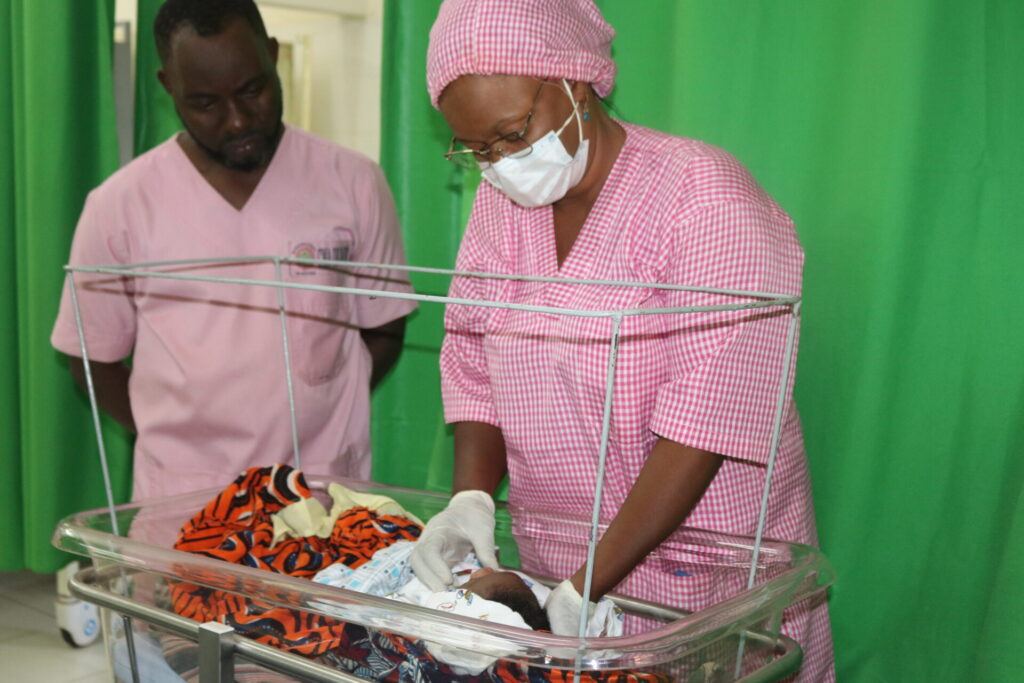
Changes in work practices have already had an impact on the quality of care. Khady recalls: “Before, everything was done mechanically. Now, good practices, particularly those focused on patient care, have become spontaneous: informing patients, talking to them, explaining what we are going to do.”
The teams are also much better at preparing equipment, anticipating possible complications. “They always have resuscitation equipment for the baby ready, or vacuum extraction equipment in case there is a problem during delivery. The technique is there, but with an added dimension of quality. We are reducing infections by improving hygiene, and improving the detection of malnutrition.”
The patients themselves feel the difference. They appreciate the way they are welcomed and supported by the participants. “Behaviour change takes time, but if we continue to support them, we will see an improvement in everyday practices that patients appreciate,” says Khady.
A different professional experience
For Khady, being a midwife is both challenging and deeply rewarding. “It’s a job that involves stress, tears and laughter, sometimes all in the same day. But supporting women, listening to their stories, seeing the joy of a family when a baby arrives… that’s what I love about it. When a woman is in front of me, I can’t let her leave without being satisfied.”
Her journey with the Academy has also been marked by exchanges and learning with other clinical mentors. Before arriving in Bobo-Dioulasso, she underwent induction training in Mali with the Academy teams.
I didn’t come to Bobo blindly, and when I arrived, I was accompanied by a senior mentor who helped me a lot. He put me at the forefront and let me take the lead, while supporting me in the process. Thanks to him, I quickly became independent.
She would like to apply the methods she discovered here to her future training work. “The training approach is very different. We start by explaining, then we do a simulation as if it were real, and then the learner and mentor go out into the department together. We accompany the midwife to put what we have learned into practice right away. It’s a progressive and active approach that I want to use again.”
Through her testimony, Khady illustrates the core mission of the MSF Academy for Healthcare: to strengthen technical skills in order to improve the quality of care, directly benefiting patients. “It’s not that everything is perfect now, but step by step, with support, we are changing everyday practices. And the patients can see that.”