
Behind the MSF Academy’s learning programmes in Yemen are the voices of those who took part. In this article, nurses, clinical mentors and a manager at Ad Dahi hospital share their experiences of the Basic Clinical Nursing Care programme implemented in 2025, reflecting on how it has influenced their practice and the care they provide to patients and their communities.
. . .
Abdullah Enqad
MSF nurse, Ad Dahi rural hospital, Yemen
The training reminded me that being a nurse is not only about providing medical care
“I come from a rural village where there were no health facilities. I decided to become a nurse because of what my family experienced. My mother lost her baby after a complicated delivery because there was no doctor and nowhere to go for care. She had waited more than 11 years for that pregnancy. That experience stayed with me from childhood and shaped my decision to work in healthcare. The training with the MSF Academy offered me new skills and strengthened the nursing skills I already had. It also reminded me that being a nurse is not only about providing medical care – we also have a responsibility to communicate with patients and their families, listen to them, and support them during difficult moments.”
. . .
Salwa Al-Qubati
MSF nurse, Ad Dahi rural hospital, Yemen

Today, I feel proud that my family and others in the community can rely on me for medical advice
“I became a nurse because my mother was often sick, and we had to ask other people to come and help with her medical care, like giving injections or checking her blood pressure – sometimes late at night. I wanted to be the person in my family who could provide that care and support.
Today, I feel proud that my family and others in the community can rely on me for medical advice. I am the only nurse in my family, and this responsibility means a lot to me. The MSF Academy training strengthened my clinical skills and improved the quality of care I provide. It has helped me work more effectively, which is especially important in a rural hospital like Ad Dahi, where many people depend on our support”
. . .
Fuad Al-Ashr
MSF Nursing Activity Manager, Ad Dahi rural hospital, Yemen

I noticed a clear improvement in the daily interactions nursing staff had with patients and I am proud of the progress they have made and the care they provide
“My role as nursing activity manager with MSF is to support and manage the nursing team to ensure the delivery of safe, high‑quality care to patients in the hospital.
The aim of the MSF Academy training was not only to strengthen nurses’ technical skills, but also to align and reinforce these competencies with the social mission of MSF. Through this training, nurses were supported to provide care that is both clinically sound and respectful of patients and their families. Following the training, I noticed a clear improvement in the daily interactions nursing staff had with patients and I am proud of the progress they have made and the care they provide.”
. . .
Radfan Al-Qadasi
MSF nurse, Ad Dahi rural hospital, Yemen

I am very grateful for this opportunity, as it has helped me become a better nurse for my community
“I come from a rural village where there were no health facilities, and access to medical care was very limited. Growing up in that environment made me want to work in healthcare so I could support myself, my family and my wider community.
The MSF Academy training was very beneficial and strongly focused on practical skills that we use every day in the hospital. I could clearly see its impact on my work, especially in how we assess patients and provide care with more confidence and accuracy. This improvement is reflected directly in the patients we care for at the hospital, many of whom rely entirely on MSF supported services. I am very grateful for this opportunity, as it has helped me become a better nurse for my community.”
. . .
Khalid Abu Hani
MSF Academy Clinical Mentor

We use manikins and practical scenarios that reflect real situations that staff can face with patients
“The MSF Academy training is essential because it aims to create long‑term impact on the quality of care provided to patients in the countries where MSF works, including in Yemen. The focus is not only on theory, but on developing practical skills that healthcare staff can apply directly to their daily work at the hospital.
What makes this training unique is its strong emphasis on workplace-based learning. We use manikins and practical scenarios that reflect real situations that staff can face with patients. This approach allows nurses to practice safely, build confidence and improve the quality of care they provide in a rural setting like Ad Dahi.”
. . .
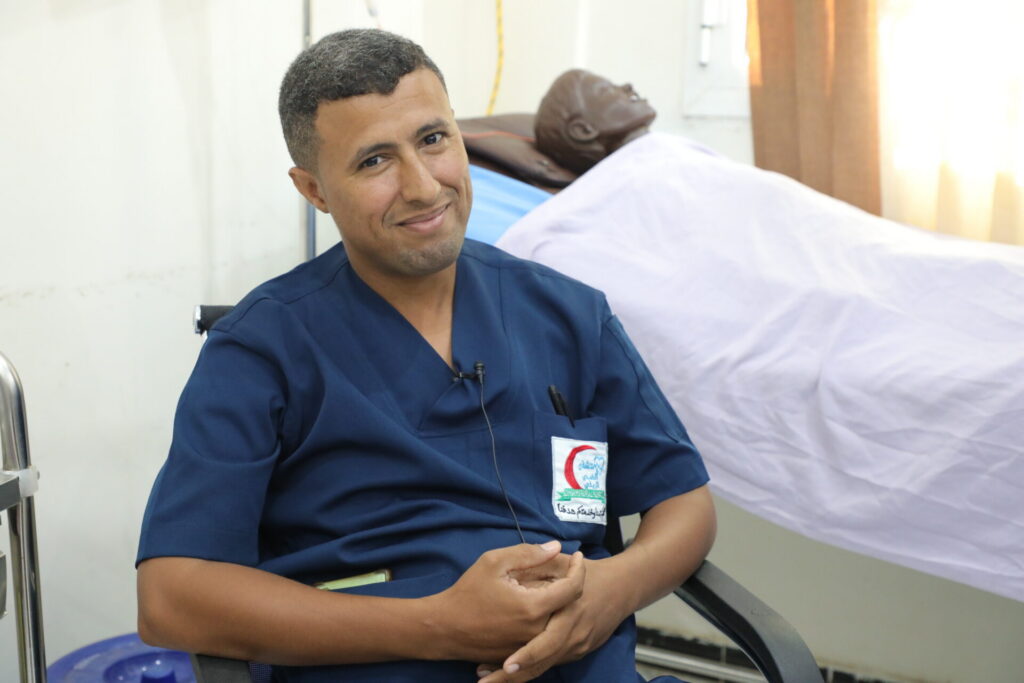
Adu Al-Ghaith Qasim
MSF Academy Clinical Mentor

Adu Al-Ghaith Qasim, clinical mentor for MSF Academy in Yemen ©Faten Hasan/MSF
As someone from the same community, I can clearly see the impact of the training on the hospital and on the care our patients receive
“I come from a rural village in Al‑Hodeidah governorate, where I am the only person working in the health sector. Health facilities are far away, so having medical skills within the community is very important as it helps provide lifesaving first aid before patients can reach a hospital. This responsibility is something I carry with pride.
Before becoming a mentor with the MSF Academy, I was the supervisor of the nurses at Ad Dahi hospital. In this role, I followed their daily work and better understood their strengths, challenges and training needs. As a result, I chose to take on the role of mentor during the MSF Academy training in order to support them more effectively.
As someone from the same community, I can clearly see the impact of the training on the hospital and on the care our patients receive. Seeing the nurses I once supervised grow in confidence and skills makes me very proud, both as a mentor and as a member of this community.”
. . .